
Home / Circuits / DIY Test & measuring /
What is beta (β / hFE of a transistor)?
The beta of the transistor is the amplification factor between the base current and the collector current. We can measure the beta of a transistor (current gain) using a voltage-current converter and current-voltage converter.
Beta (β) is a characteristic of each transistor. This feature is found in the NTE, ECG manuals, etc. These manuals have minimum or approximate values of the real values. This means that we do not know the real beta of a specific transistor.
Keep in mind that two transistors with the same name (e.g., 2N2222) may have different betas. The circuit below allows us to obtain the value of beta for a specific transistor.
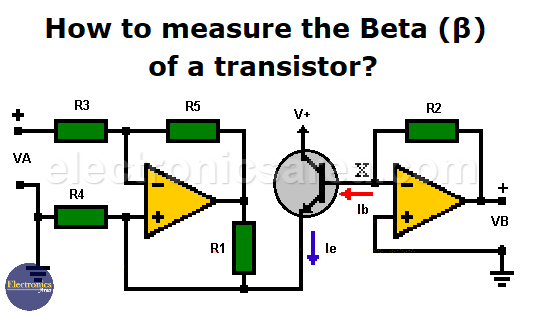
Circuit to measure beta of a transistor
How does the circuit to measure beta of a transistor work?
This circuit comprises a voltage-to-current converter on the left side of the transistor and a current-to-voltage converter on the right side (see the circuit diagram). The voltage to current converter controls the emitter current of the transistor, and the current-voltage converter controls the base current of the transistor.
The current-voltage converter is easily implemented, with an inverting amplifier that does not use an input resistor. The base current flows through the virtual ground (point X), whose voltage is not affected by the current, while the output VB is proportional to this current (Ib), at the input of the operational amplifier.
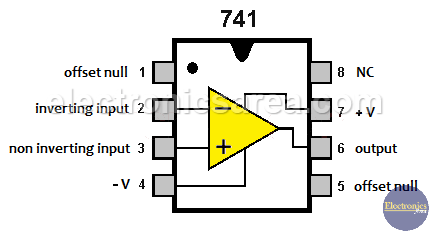
The part of the circuit that controls the emitter current is a current-voltage converter and supplies the emitter current of the transistor. The base of the transistor is 0 V (virtual earth between the inverter and non-inverting terminals of the operational amplifier) so that the voltage on the emitter is -Vbe.
The emitter current is set with the input voltage of the voltage-current converter, and the resulting current (base current) is obtained by measuring the output voltage of the current-voltage converter.
Beta (β) = 1 + Ie/Ib. As Ie = VA/R1 and Ib = VB/R2
Beta (β) = 1 + VA/R1 x R2/VB = 1 + [VA x R2] / [VB x R1]
With R1 = R4 = 1k, R2 = R3 = R5 = 100k, Beta (β) = 1 + [VA x 100k] / [VB x 1k].
The beta of a transistor (β) is obtained using the formula: beta (β) = 1 + 100 (VA/VB).
More DIY Test & Measurement Circuits
- How do I test a Zener diode? – A simple method
- Diode tester circuit with 741
- Audible continuity tester
- Continuity tester using 741 IC
- 555 Timer tester circuit
- Op Amp Tester circuit diagram
- How to protect the 500mA fuse of a multimeter?
- How to make a current flow indicator?
- How to measure Beta of a transistor?
- Logic Probe using NOT gates
- Acoustic Logic Probe using the 555 Timer
- Logic Probe with 7 segment display
- Logic Probe circuit using CD4001 IC
- Logic Probe using two transistors


