
Electronics Area – Electrical and Electronics Tutorials and Circuits
Welcome to Electronics Area
Electrical and Electronics Tutorials and Circuits
Recent posts
Automatic Water Level Controler Circuit
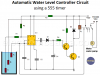
This circuit ensures that an elevated tank always has enough amount of water. Perfect for 2 or more stories buildings or houses
Variable Power Supply with LM317 & Boost Transistor – (4A)
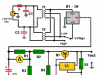
Variable power supply with LM317 and boost transistor (4 amps) circuit. How it works. The high/low voltage selector switch. List of components
Series and Parallel Capacitors
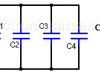
Series and Parallel Capacitors. Obtaining the equivalent capacitance of series capacitors and parallel capacitors. Formulas and examples
Temperature Alarm using thermostats
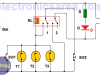
Temperature Alarm using thermostats
This simple alarm with thermostats circuit can be used on places where we must detect overheating. It uses 3 thermostats, and a one 2 contact, relay
Series/Parallel Resistor Reduction
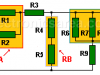
Series/Parallel Resistor Reduction. Resistors reduction can be done, making some simplifications using resistors in series and resistors in parallel formulas.
Inverting Summing Amplifier using Op-Amp
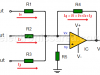
The inverting summing amplifier using an op-amp outputs a voltage equal to the sum of the voltages it has in its inputs. The explanation is based on an adder of three inputs but applies to an adder of any number of inputs
Automatic Night Light with 555 and relay
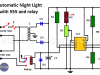
This automatic night light using 555 IC turns on lights when there is no daylight. The circuit is perfect for lighting single places such as the garden, the front door of the house, the entrance to the garage, etc.
Millman’s Theorem – Millman’s equivalent circuit
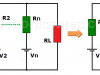
Millman’s theorem is used to directly obtain the voltage between the ends of a parallel branch circuit. Equivalent Millman circuit Formulas, example.
Window comparator using Operational Amplifiers
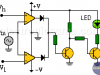
A window comparator lets you know if a signal is within or outside a previously defined acceptable voltage limit.
Electronic sound control Circuit (applause)
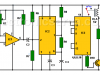
This electronic sound control circuit works like a sound activated relay and can activate or deactivate a device connected to it, by two consecutive claps.
Push – Pull Amplifier – Push – Pull Amplifier Operation
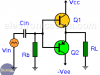
Push – Pull Amplifier
A Push – Pull amplifier is called that way, because it uses 2 groups of transistors and only one works at a time. One group pushes in one direction while the other pulls in another direction. Each group is responsible for amplifying a single phase of the input wave.
PUT – Programmable Unijunction Transistor
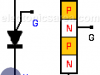
What is a PUT?
PUT – Programmable Unijunction Transistor. Main characteristics. PUT and UJT. Oscillator circuit design and waveforms. Frequency formula