
Home / Transformers /
Transformer cores are laminated
You all know that the transformer cores are laminated. Someone will have wondered if it would not be easier to use a compact iron block.
If you are looking for an explanation for this purpose, you will not find it easily. So we will try to illustrate as simply as possible the reason why it is not possible to use a solid iron core instead of a core that is laminated.
By inserting a solid iron core into the transformer, when it is subjected to an alternating magnetic field, parasitic currents run inside it (eddy currents) that heat it up.
In reality, the same situation occurs as if we wrapped a large loop around the transformer core and short-circuited the two ends together.
Why are transformer cores laminated?
Transformer cores are laminated to neutralize these eddy currents; it is necessary to section the core into very thin sheets. Isolating them from others by means of a layer of varnish or oxide in such a way that even if one exceeds the other, the eddy currents in a sheet could never be short-circuited with the currents of the adjacent sheets.
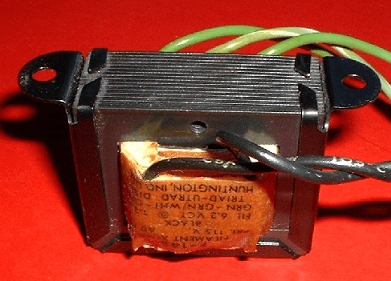
ArnoldReinhold at en.wikipedia / CC BY-SA
The standard sheets currently on the market are 0.50 mm thick, and only the “special” type is 0.35 mm thick.
Obviously, those with a thickness of 0.35 mm have higher performance because the losses caused by scattering and by eddy currents are lower
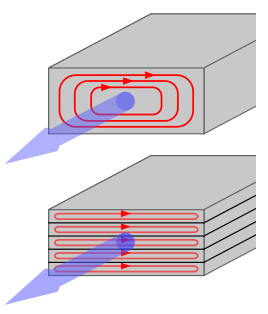
Laminating of core – The Core-laminated Transformer
By Svjo – Own work, CC BY-SA 3.0, Link
We must point out that eddy currents and hysteresis losses increase considerably with increasing working frequency. So the laminated cores can only be used in low frequencies up to a maximum of 20,000 to 30,000 Hz.
To work at frequencies between 10,000 and 100,000 Hz, it is convenient to use ferrite cores composed of microscopic iron grains joined by special glues that isolate them from each other.
The lighter the core, the less iron powder is in its body, so the higher its working frequency will be.
The very heavy ferrite cores are capable of working up to a maximum frequency of 2 MHz, the lightest ones up to 20/50 MHz, and the very light ones even at frequencies above 100 MHz.
core-laminated-transformer
More Transformer Tutorials
- Ideal Transformer Working Principle
- Transformer Turn Ratio (K)
- Impedance matching Transformer
- Autotransformer
- Transformer Structure
- Power Transformer usage
- Equivalent transformer circuits (power, audio, video and RF)
- Why is the core of a transformer laminated?
Transformer tutorials Main Category


