
Transformers
Home /
The Electrical Transformers
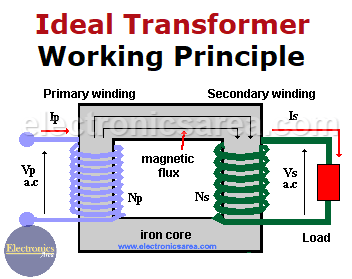
Transformers are devices used to increase or decrease an alternating current (AC) voltage applied to their primary winding. If the transformer is considered ideal, the amount of energy delivered at its input should be equal to the amount delivered at its output by the secondary winding. The transformer coils are insulated from each other.
When an AC voltage is applied to the primary winding, it receives an alternating current that generates a changing magnetic field. This magnetic field travels through the transformer core and induces an AC voltage at the terminals of the secondary winding.
What is a transformer used for?
Transformers can be used to increase and decrease voltage.
Step-up Transformers
These transformers are typically used to transmit electricity over long distances. When a transformer increases the voltage, the current it delivers is reduced inversely and proportionally. This means that if the voltage increases tenfold (multiplied by ten), the current decreases tenfold (divided by ten). This allows for the use of a thinner (and therefore cheaper) conductor for current transmission.
Step-down transformers
These transformers are primarily used in the process of obtaining direct current (DC). A voltage of 110/220 VAC is applied to the transformer, which reduces it to a lower-amplitude AC voltage so that it can be rectified and regulated to obtain a DC voltage. These transformers are widely used in chargers of all kinds: computers, sound equipment, cell phones, etc.
Electrical Transformers Tutorials
Autotransformer – How does it work? Step-up, step-down
Autotransformer. How does it work? . Step-up, step-down. Applications. Advantages. Conventional transformer connected as an autotransformer.
Transformer Structure
Electric Power Transformer Structure. All electric transformers, have three fundamentals parts: high voltage winding, low voltage winding and Core.
Equivalent transformer circuits (power, audio, video and RF)
Equivalent transformer circuits (power, audio, video, and RF). Normally, in the designs and analyses where transformers are used, it is very common to use the characteristics of the transformer as if it were an ideal transformer.
Power Transformer usage

The Electric Power Transformer usage. The transformers allow the modification of the voltage and the current values, so they can take the appropriate one to carry and distribute the electric energy.
Impedance matching Transformer
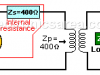
An impedance matching transformer is used to couple an antenna to a transmission and / or reception equipment. It was widely used in the coupling of the antenna to the analog television, by radio amateurs
Transformer Turn Ratio (K)
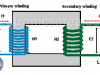
3 ways to find the transformer turn ratio K. Using the winding number of turns, using electromotive forces, and using winding currents. The ideal transformer and the transformer turn ratio.
Transformer cores are laminated. Why?
Transformer cores are laminated. Why is it not possible to use a solid iron core instead of a core-laminated one? What are Eddy’s or Foucault’s currents?
Ideal Transformer Working Principle
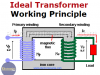
Ideal transformer working principle. How the transformer works. Voltage & current transformation ratio. Power ratio between primary & secondary windings