
Guitar Synthesizer Using the CD4046
This guitar synthesizer circuit produces a synthesizer-like sound when used with a guitar. The CMOS PLL CD4046 integrated circuit produces an unusual sound that closely resembles a synthesizer when used with a guitar.
The CD4046 is an integrated circuit consisting of a phase-locked loop (PLL) with a low-power voltage-controlled linear oscillator (VCO) and two phase comparators with a common input signal to the amplifier and a common input to the comparator.
How the Guitar Synthesizer Works
Two of the amplifiers in the CD4007 are used to amplify the signal coming from a guitar. See the diagram.
The phase comparator uses the amplified signal to block the VCO at the frequency of the musical note being played. The VCO will not oscillate until the tone sounds, provided that the low-pass filter shown in the diagram is used. See resistor R3 and capacitor C4.
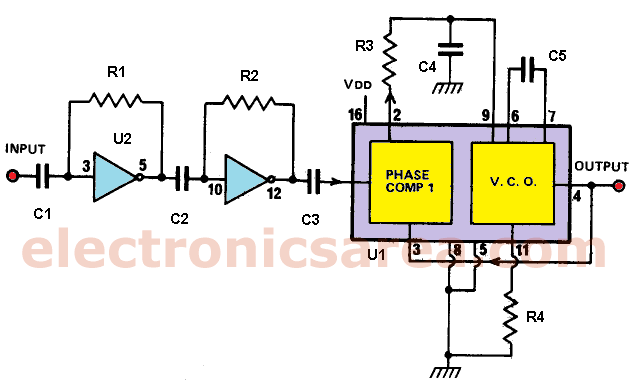
Guitar Synthesizer Using the PLL CMOS 4046 IC
Increasing the value of resistor R3 causes the VCO to oscillate continuously at approximately one kilohertz without an input signal. This enables smooth transitions between different musical notes.
The base frequency can be adjusted by changing the value of resistor R4.
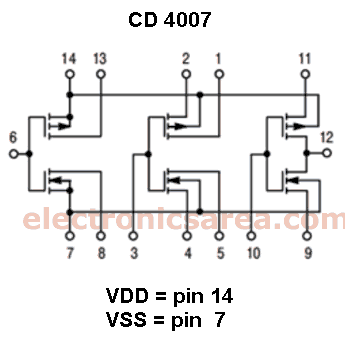
CD4007 CMOS IC pinout
List of Guitar Synthesizer Components
- 1 PLL CMOS 4046 IC (U1)
- 1 CMOS CD4007 IC (array of MOSFET transistors) (U2)
- 2 4.7M resistors (R1 and R2)
- 1 100k resistor (R4)
- 1 15k resistor (R3)
- 4 100 nF (nanofarad) capacitors (C1, C2, C3 and C4)
- 1 10 nF capacitor (C5)
Original design by: R. Barnett
More Audio Circuits
- 2 watt audio amplifier with the TDA2822M IC
- 6 watt audio amplifier with TDA2613 (Hi-Fi)
- 400 watt stereo amplifier with STK4050
- 4-channel audio mixer using LM3900 IC
- Microphone mixer using operational amplifiers
- 6 LED VU meter using a single transistor
- Audio splitter – 1 Input – 4 Outputs
- Audio level indicator using LM339
- 8 LED VU meter using LM324 IC
- Music box using a CD4017 and Two 555
- Metronome with adjustable BPM
- Tone generator using two 555 timers
- How to add a tweeter to a baffle or speaker
- Guitar Synthesizer using CD4046


