
Temperature Alarm Circuit Using a Diode
The diagram below illustrates the use of a semiconductor diode as a temperature sensing element in a temperature alarm circuit that employs an operational amplifier.
Semiconductor diodes can be used as temperature sensors because their forward voltage changes as the temperature changes. The advantage of diodes is that the relationship between their voltage and temperature is virtually linear.
How does a temperature alarm circuit that uses a diode work?
In this circuit, the 5.6 V Zener diode is connected in series with resistor R1. This creates two voltage dividers, R2-R3 and R4-D1, with a constant voltage of 5.6 V between their ends. A constant current practically circulates for each of these dividers.
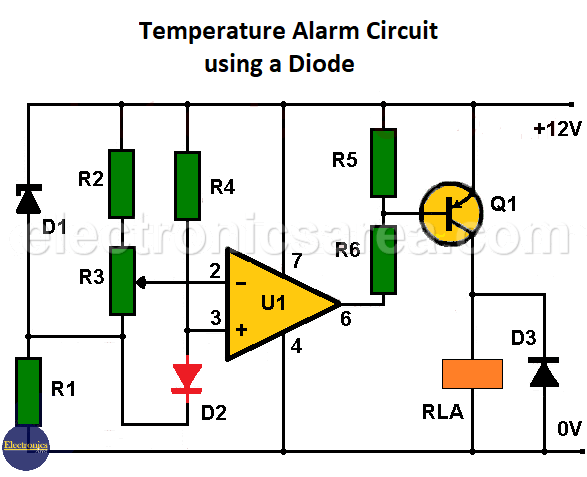
Temperature Alarm Circuit Using a Diode
So, we have:
- A constant reference voltage between the junction of the R2 and R3 resistors and pin 2 of the operational amplifier (op amp), and …
- A temperature-dependent voltage with a coefficient of -2 millivolts per degree Celsius (mV/°C) between the junction of the R1-R3 resistors and pin 3 of the op amp.
A differential voltage of -2 mV/°C appears between pins 2 and 3 of the amplifier. To tune the circuit, raise diode D2 to the desired temperature level and slowly turn potentiometer R3 just before energizing the relay.
At this point, a differential voltage of 1 millivolt (mV) appears between pins 2 and 3 of the operational amplifier (op amp), with the voltage at pin 3 below that at pin 2. This activates transistor Q1 and the relay.
When the temperature drops below the trigger level, the voltage on pin 3 increases by approximately 2 mV/°C above the voltage on pin 1. This de-energizes transistor Q1 and the relay.
The circuit has a typical sensitivity of 0.5°C and can be used as an over-temperature alarm. It operates from below 0°C to above the boiling point of water, 100°C.
The circuit can be reversed to act as a low-temperature alarm by switching the connections between pins 2 and 3 of the op amp.
List of components for the temperature alarm circuit:
- 1 741 operational amplifier (U1)
- 1 2N3702 PNP transistor (Q1)
- 1 5.6 V Zener diode (D1)
- 2 common semiconductor diodes (D2 and D3)
- 1 9 V relay (RLA)
- 3 1.2 kΩ resistors (R1, R5, and R6)
- 2 4.7 kΩ resistors (R2 and R4)
- 1 1 kΩ potentiometer (R3)
For more schematics like this one, visit the main page of Alarm projects.
Here are some other temperature alarms you may like:
- Car Temperature Alarm using 741 & 555 ICs
- Over temperature alarm circuit using Thermostat
- Temperature alarm circuit with Op. Amp.
- Temperature Alarm u with thermostats