
Energy and Electric power
Electrical energy is the energy resulting from the flow of electric charge. Electrical energy is usually encountered as potential energy, which is energy stored due to the relative positions of charged particles or electric fields.
Electric power is the rate, per unit of time, at which electrical energy is transferred by an electric circuit, or the electric power is the rate or speed at which work is done.
Electric power is the multiplication of the electric current (amps) by the voltage (volts).
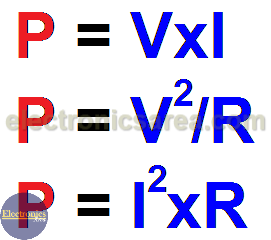
- P = I x V (watts) [1].
Using Ohm’s law (V = I x R), we obtain the following formulas that we can use to find the power lost in a resistor.
- P = [V/R] x V. P = V2/R [2] and …
- P = [I/R] x I. P = I2 x R [3].
Finding the power dissipated as heat in a resistor using the last 3 formulas
What is the power dissipated in a resistor if the current I is 0.25 amperes and the voltage V is 3 volts?
- Using the #1 formula, the power is P = I x V = 0.25 x 3 = 0.75 watts = 750 milliwatts.
- Using the #2 formula, we can get electric power without the current value and
- Using the #3 formula, the power is obtained without the voltage value.
These formulas are useful for finding the power in a resistor, where the energy is converted into heat.
But not always is electricity converted into heat.
- In an electric motor, the power is converted mainly into mechanical motion.
- In radio and television stations, power largely becomes electromagnetic waves.
- In a stereo, power becomes sound waves.
- In a light bulb, power becomes light and heat.
Normally the power, converted into heat, is considered lost power or useless power. The main idea is that the power supplied is to make the most of it and that the power lost in heat and others is minimal. To find out how well the power is used, we use the term “performance”.
What is performance?
Performance = output power / input power.
For example, if we use a 100-watt light bulb and the power transformed into light is 80 watts. The input power is 100 watts and the output power is 80 watts; the performance is 80/100 = 0.8 = 80%. The remaining 20% is lost in heat.
The unit of electrical power is a watt. Multiples and sub-multiples of what are the following:
- 1 nanowatt = 1 nW = 1 watt / 1 000 000 000.
- 1 microwatt = 1 uW = 1 watt / 1 000 000.
- 1 milliwatt = 1 mW = 1 watt / 1000.
- 1 kilowatt = 1 kW = 1000 watts.
- 1 megawatt = 1 MW = 1000 kilowatts = 1 000 000 watts.
- 1 gigawatt = 1 GW = 1000 MW = 1 000 000 000 watts.
- 1 Terawatt = 1 TW = 1 000 000 MW = 1 000 000 000 000 watts.
Note: 1 HP (Horsepower) = 745.7 watts.


