
Operational Amplifier Tutorials list(Op Amp)
Home /
What are operational amplifiers?
Operational amplifiers, also called op-amps, were originally designed to perform mathematical operations in analog computers, such as addition, subtraction, multiplication, division, integration, differentiation, etc. It is from this initial application that it gets the name “operational amplifier”, because the idea was that it originally performed the operations mentioned.
A Brief History of the Op-Amp
Op Amp stands for operational amplifier. The operational amplifier was developed in the early 1940s for use in analog computers. The first op-amps used vacuum tubes, which were very large and very power-hungry.
In 1967, Fairchild Semiconductor introduced the first operational amplifier in an integrated circuit package, reducing its size, power consumption, and price. This device is a high-performance linear amplifier with a wide range of applications.
Basic operation of the operational amplifier
The operational amplifier has:
- An inverting input, labeled with a minus sign (V–), where the applied signal remains in phase with the output.
- A non-inverting input, labeled with a plus sign (V+), where the applied signal is phase-shifted by 180 degrees with the input.
An output that delivers the amplified difference between the two input signals. Voutput = A(V+ – V–). Where A is the open-loop gain of the operational amplifier, which is between 100,000 and 1,000,000. This large gain can be controlled with a suitable feedback network.
Characteristics of an Ideal Op-Amp
- Infinite gain
- Infinite input impedance (Zin), meaning it draws no current from the signal source.
- Zero output impedance (Zo), meaning it can deliver a large amount of current to the load without voltage drop.
- Infinite bandwidth.
- No output offset errors.
These characteristics, with some limitations, are very similar to those of a real operational amplifier.
Operational amplifier tutorials list
Inverting Summing Amplifier using Op-Amp
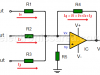
The inverting summing amplifier using an op-amp outputs a voltage equal to the sum of the voltages it has in its inputs. The explanation is based on an adder of three inputs but applies to an adder of any number of inputs
Window comparator using Operational Amplifiers
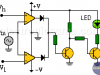
A window comparator lets you know if a signal is within or outside a previously defined acceptable voltage limit.
Op-amps with a single rail power supply. How to?
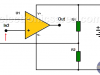
Method #1: Voltage divider using two resistors. Method #2: Voltage divider using two Zener diodes.
Non-inverting Op-Amp
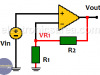
How to find the voltage gain (formula) in a non-inverting Op. Amp. How to find the Input impedance (Zi) and output impedance (Zo) of a non-inverting operational amplifier.
Operational Amplifier as a Comparator
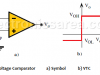
An op-amp can work as a comparator (voltage comparator) when the differential gain in the open loop is high and the speed is not a critical factor
Op Amp Voltage follower / Voltage Buffer
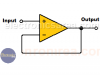
A buffer has an output that is exactly like the input. This feature is very useful for solving impedance matching problems.
Op Amp Open Loop Gain – Op Amp Open Loop Configuration
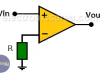
Op Amp Open Loop Gain – The open loop gain of the operational amplifier is given when there is no feedback path between the output and either input