Home / Semiconductors /
What is a DIAC?
A DIAC (Diode for Alternating Current) is a bidirectional trigger diode that is specially designed to trigger a TRIAC and a thyristor. This component is a voltage-triggered device and has two terminals, MT1 and MT2. It works like two Zener diodes connected in parallel but oriented in opposite directions.
How a DIAC works
Conduction occurs when the voltage value of the Zener diode, which is connected in the inverse direction, is exceeded. In other words, a DIAC is a diode that conducts electrical current only after its breakdown voltage VBO has been momentarily reached.
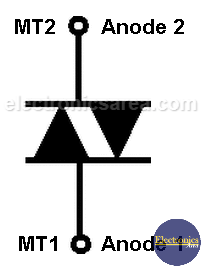
DIAC symbol
This component does not conduct in its normal state, but it exhibits a small leakage current. Activation occurs when the activation voltage is reached. At this point, the voltage across its terminals drops. The voltage drops cause conduction and allow current to flow, triggering the SCR or TRIAC.
The DIAC is mainly used in power control applications (dimmer, motor speed control, heat control, etc.), using the phase control technique. Its characteristic curve is shown below.
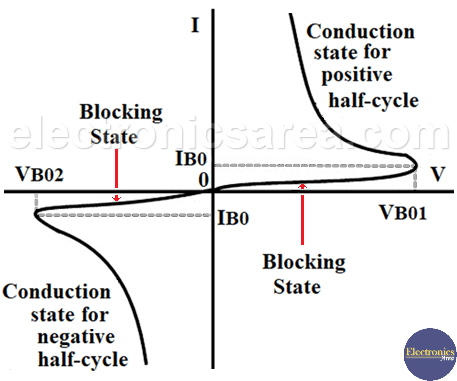
The characteristic curve shows that when
- +V or -V is less than the trigger voltage (‘breakdown’ voltage / VBO), it works like an open circuit
- +V or -V is greater than the trigger voltage; it works like a short circuit
DIAC Internal Structure and Equivalent circuit
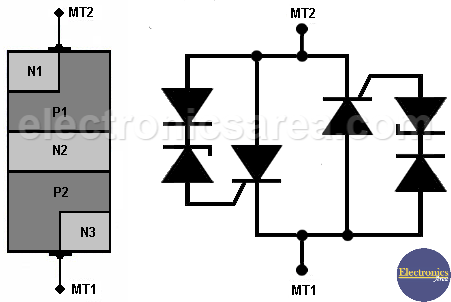
Diode for Alternating Current Main Characteristics:
- Trigger voltage.
- Trigger current.
- Symmetry stress (see previous image).
- Recovery voltage.
- Power dissipation (They are manufactured with the ability to dissipate power from 0.5 to 1 watt).
You may also like:
- The SCR (Silicon Controlled Rectifier)
- The TRIAC (Triode for Alternating Current)
- The SBS (Silicon Bidirectional Witch)
Application: Dimmer / AC Motor speed controller circuit
It is typically used in circuits that control the phase of the current passing through a TRIAC so that only voltage is applied to the load for a fraction of the input voltage cycle.
It can be used in lighting control (dimmer), for speed control of an AC motor, electric heating, etc.
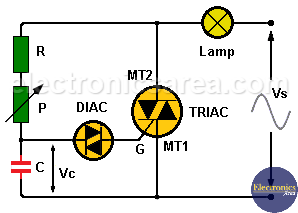
List of circuit components
- 1 3.3K resistor (R)
- 1 250K ´potentiometer (P)
- 1 0.1uF capacitor (C)
- 1 ST2 DIAC
- 1 BTA06-600A (5 amps) TRIAC or equivalent