Home / Semiconductors /
What is an SBS?
The SBS, or Silicon Bidirectional Switch, or Silicon Bilateral Switch, is a 4-layer, 3-terminal symmetrical low-power device used on trigger applications that use TRIACs, SCR, etc., etc. The SBS is more versatile than the DIAC.
It also has an additional terminal (gate, or G). This gate allows you to modify its trigger characteristics with small pulses of current (tens of microamperes (uA)).
Its low cost, high speed, and ability to trigger thyristor gates with high current values make this device very useful in many applications. The silicon bilateral switch is not only an improved version of the four-layer diode but is also manufactured as an integrated circuit consisting of transistors, diodes, and resistors.
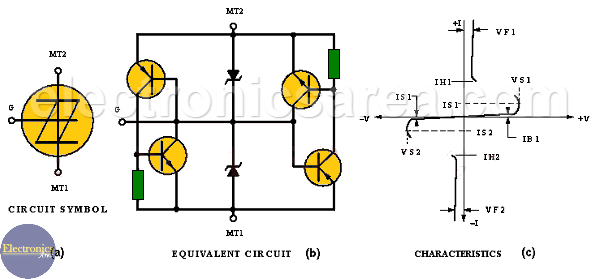
- Diagram (a) shows its symbol
- Diagram (b) shows the structure at the circuit level, and …
- Diagram (c) shows its I-V characteristics.
The Motorola MBS4991 is a typical example of a symmetrical silicon bidirectional switch.
Silicon Bilateral Switch Main Characteristics
Its main characteristic parameters according to diagram (c) are:
- Switching voltage V = 8 V (VS1).
- Switching current I = 175 μA (IS1).
- Holding current I = 0.7 mA (IH1).
- ON state forward voltage V = 1.4 V (VF1).
To trigger this device, it is necessary to exceed the switching voltage V = 8 volts (VS1) or to apply a gate current I = 200 uA. (IS1).
You may be interested in:
- The SCR (Silicon Controlled Rectifier)
- The DIAC (Diode for Alternating Current)
- The TRIAC (Triode for Alternating Current)