Electrons, protons, and neutrons (positive and negative charges)
Everything around us is made up of electrons, protons, and neutrons. Often, the number of protons and electrons is not equal (meaning the body is not electrically balanced).
A body is said to be negatively charged if it has more electrons than protons and positively charged if it has more protons than electrons. When the number of protons and electrons is equal, the body is neutral, meaning it has no charge. The following diagram shows two uncharged bodies.

A neutral body has positive and negative charges.
For a body to be charged, either positively or negatively, it must be affected in some way. One way to alter a metal body is to heat it. In this case, the body gains or loses electrons, while the number of protons generally remains constant.

The electron lives in the body, which has positive and negative charges.
When electrons pass from one body to another, the body that loses electrons becomes positively charged, while the body that gains electrons becomes negatively charged. This movement of electrons is called an electric current.
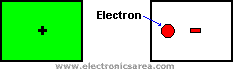
The electron enters the body, creating positive and negative charges.
Metals allow electrons to flow easily. This flow may be due to electrostatic forces. In this case, the electrons are said to be under the influence of an electrostatic field, also known as an electric field.