Coulomb’s Law—Electrostatic Force: Formula and example. Learn how to calculate the electrostatic force between 2 electric charges using Coulomb’s Law.
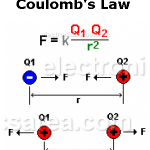

Coulomb’s Law—Electrostatic Force: Formula and example. Learn how to calculate the electrostatic force between 2 electric charges using Coulomb’s Law.
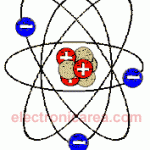
Structure of Matter: The Bohr Atom and Electricity. The atom, the electron. Positive and negative ions. How free valence electrons become electricity

If the electric field at a given point is known, the electrostatic force on a charge Q at that point can be found. If a charge Q is subject to an electrostatic force, an electric field exists.
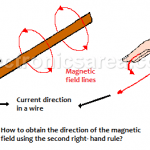
Second Right-Hand Rule. When a current flows through a conductive wire, a non-visible effect called the electromagnetic field is generated around it.
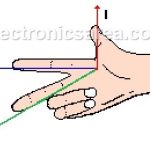
The First Right-hand Rule or (Magnetic Force induced on a Current-Carrying Wire) says that if a current-carrying wire is in the presence of a magnetic field, a force is exerted on the wire.

Static electricity is static, since it is a current that is going nowhere. Both, DC and AC current flow in some direction, but static electricity does not.
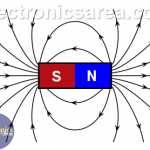
Magnets. Charges in motion (electric current) behave like magnets (produce magnetic fields)
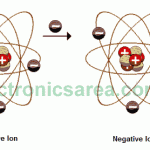
The electron (or proton, since they have the same charge) is the basic unit of electric charge. We can therefore consider the electron as the elementary unit of electric charge.
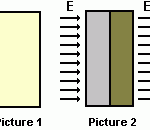
If an electric field is close to a metallic body, part of it is positively charged and other part negatively charged

If a body has more electrons than protons, it is negatively charged. If it has more protons than electrons it is positively charged